
A brief by any other name is still a brief, even if it evokes more questions than answers. Fortunately, architects Arun Shekar and Mohammed Afnan, by their own admission, have always been the nosy kind, so when it came to designing a bungalow in Kerala with a fluid brief, the principals and co-founders of Kozhikode-based AD100 design practice Humming Tree weren’t afraid to ask questions. “To be fair, there was a brief, but they were kind enough to give us free rein over the design,” says Shekar. The prompt from the owners, Jacob Pulimootil and Anekha Joseph, was clear: to design a home that looked lived-in. “They wanted it to feel cosy, but they weren’t sure what that would look like,” notes Afnan. What they did know was that they wanted a place nary too precious, a place where they could hang up their boots, forget about the world, and become temporarily invisible.
Jacob and Anekha didn’t mind new things—as long as they didn’t look new. “We went for materials and furniture that looked like they had a past life, even if they didn’t,” shares Shekar. Additions included a monolithic marble seat in the foyer, a bespoke travertine and marble table in the living room, and elsewhere, a reclaimed wood table, handwoven rugs, terracotta pots, a painting of lost horses from the 1980s, and a bespoke cane cot—all hushed in brown and beige. The flooring was muted in black and wood to camouflage everything in sight, so that you might wonder where, or whether, one space ends and another begins. In a bid to imbue the bungalow in Kerala with a sense of calm, the architects kept the decor clean and uncluttered, pairing geometric lines with plain walls and leaving enough circulation area between objects.
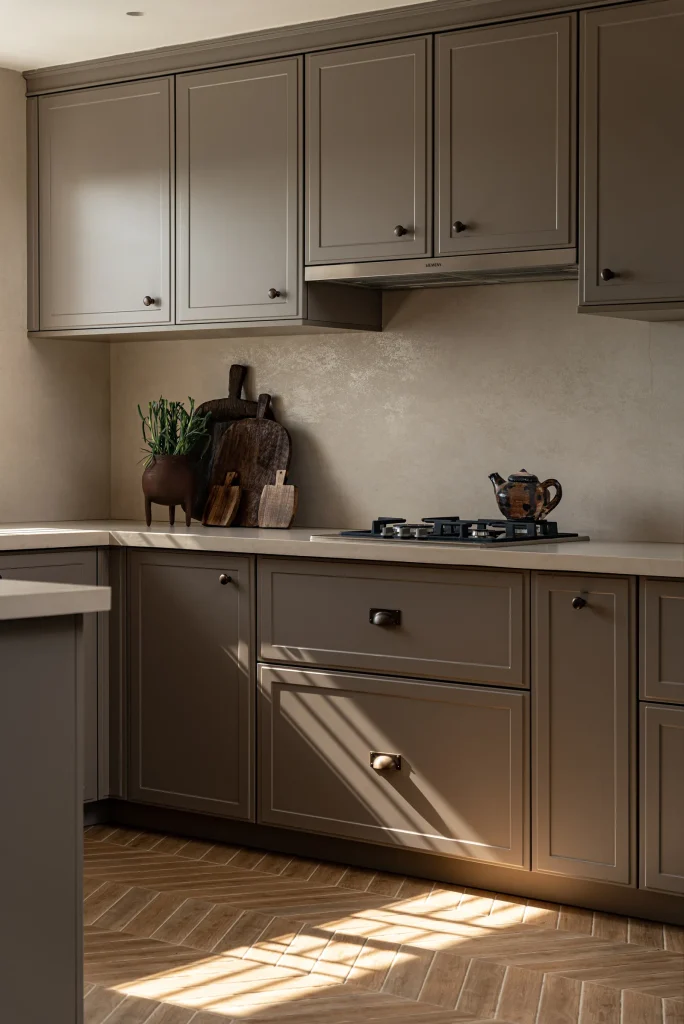
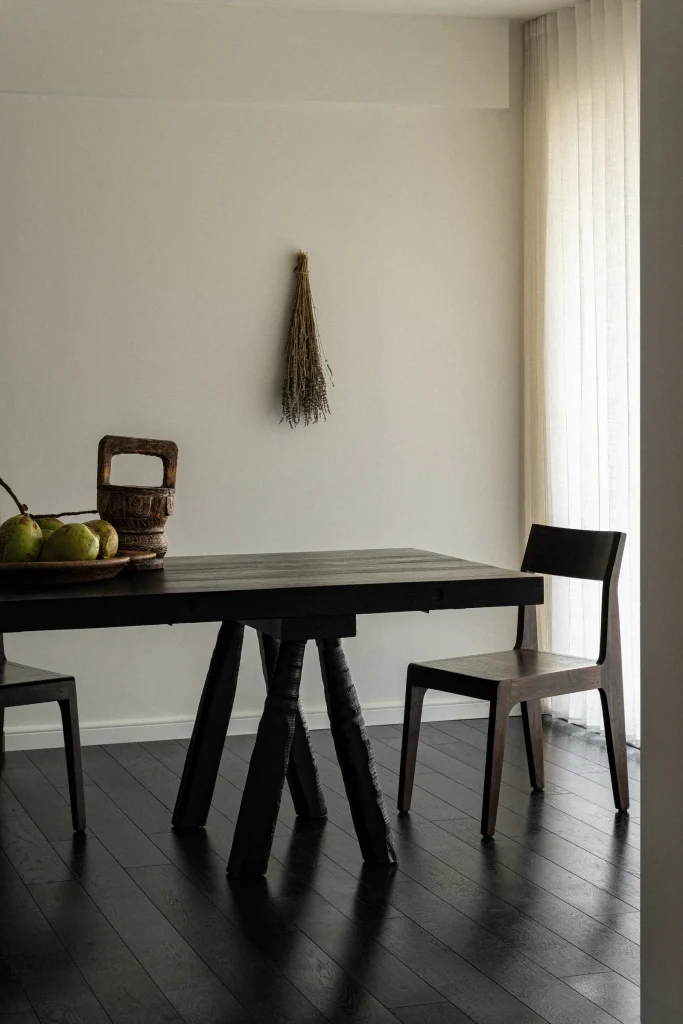
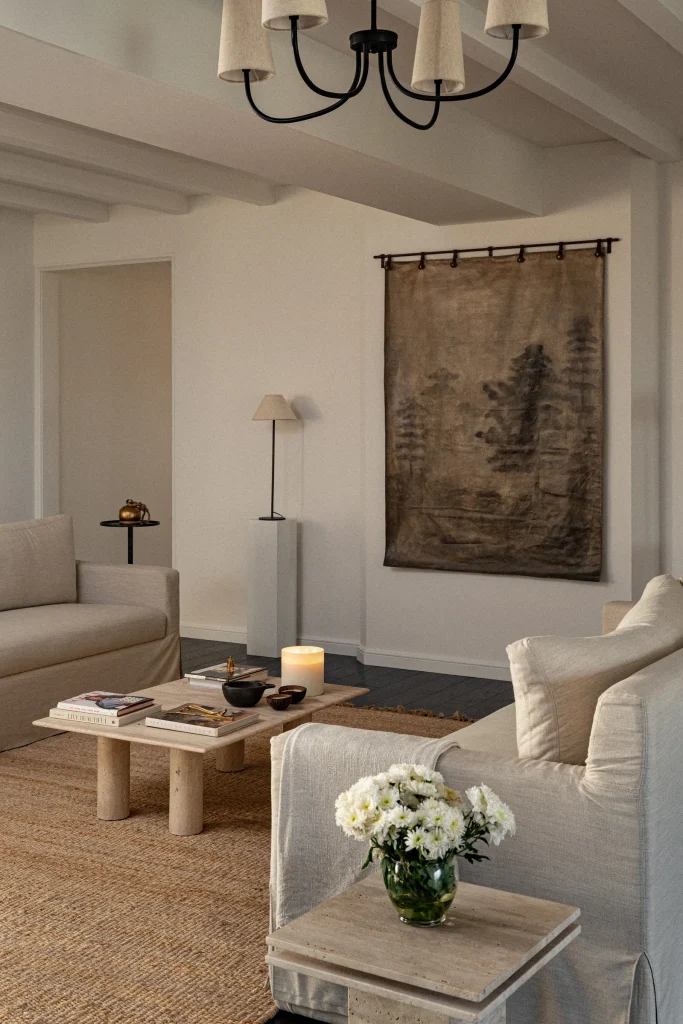
The architects didn’t subscribe to a specific style. “I guess you could call it a cross between Colin King and Kerala,” jokes Afnan. The pair paid equal attention to interior design and styling. One case in point is the kitchen, where reclaimed timber trays and jars allude to traditional craftsmanship. Similarly, the dining room, with its reclaimed wood table, harks to the Kerala hinterland. If the primary bedroom is anything to go by, it’s evident that the architects weren’t afraid to go against the grain. The nightstands and lamps flanking the bed, as well as the art above it, are perfectly asymmetrical, though hardly by accident. “We wanted to play with imperfection and introduced it where we could,” says Shekar. “The rug is hand-painted too so you’ll spot some beautiful blemishes if you look closely.” Did they have a similar philosophy for the kids’ bedroom? “We echoed the neutrals, yes, but we also specified biomorphic decor to make it kid-friendly.”
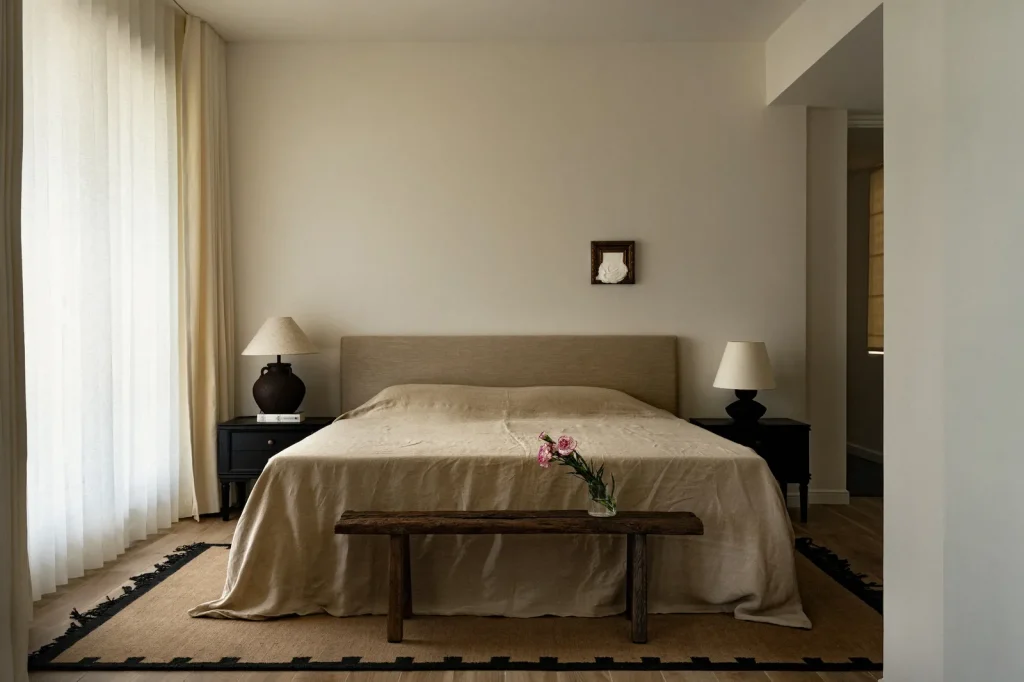
“It took a great deal of planning to get the materials and textures to look this way,” Afnan submits. “Sourcing the right mix was important as everything had to look like part of a cohesive whole.” Does the end result hold a candle to Jacob and Anekha’s expectations? “There is nothing more satisfying than hearing how much they feel at home here,” muses Shekar. For a brief that specified creating an experience that engaged all five senses, it’s clear they’ve created something truly special